

When hip pain affects your ability to walk, sleep, or get through the day, your orthopedic surgeon may recommend surgery. Two common terms often come up in that discussion: total hip replacement and partial hip replacement. Although they sound similar, they are used in very different situations, and understanding the differences can lead to a better conversation with your surgeon.
Here’s a breakdown of what each procedure involves, who it’s right for, and the recovery, risks, and long-term outcomes that you can expect before you make your decision.
The hip is a ball-and-socket joint; the “ball” is the top of your thigh bone (femoral head), and the “socket” is part of your pelvis (acetabulum). Hip replacement surgery replaces damaged parts of this joint with artificial components to relieve pain and restore movement.
| Terms | Total Hip Replacement | Partial Hip Replacement |
|---|---|---|
| What it does | Replaces both the femoral head (ball) and the acetabulum (socket) | Replaces only the femoral head, keeping the natural socket |
| Best for | Arthritis, joint degeneration, younger/active patients | Isolated femoral neck fractures with a healthy socket, typically in older adults |
| Pros | Longer-lasting relief (often 15–20+ years), better long-term mobility, treats a broader range of conditions | Shorter, less invasive surgery; generally faster initial recovery; lower dislocation risk due to larger ball size |
| Cons | More invasive, longer recovery, slightly higher surgical complexity | Higher chance of future complications if the natural socket wears down over time; not suitable for arthritis |
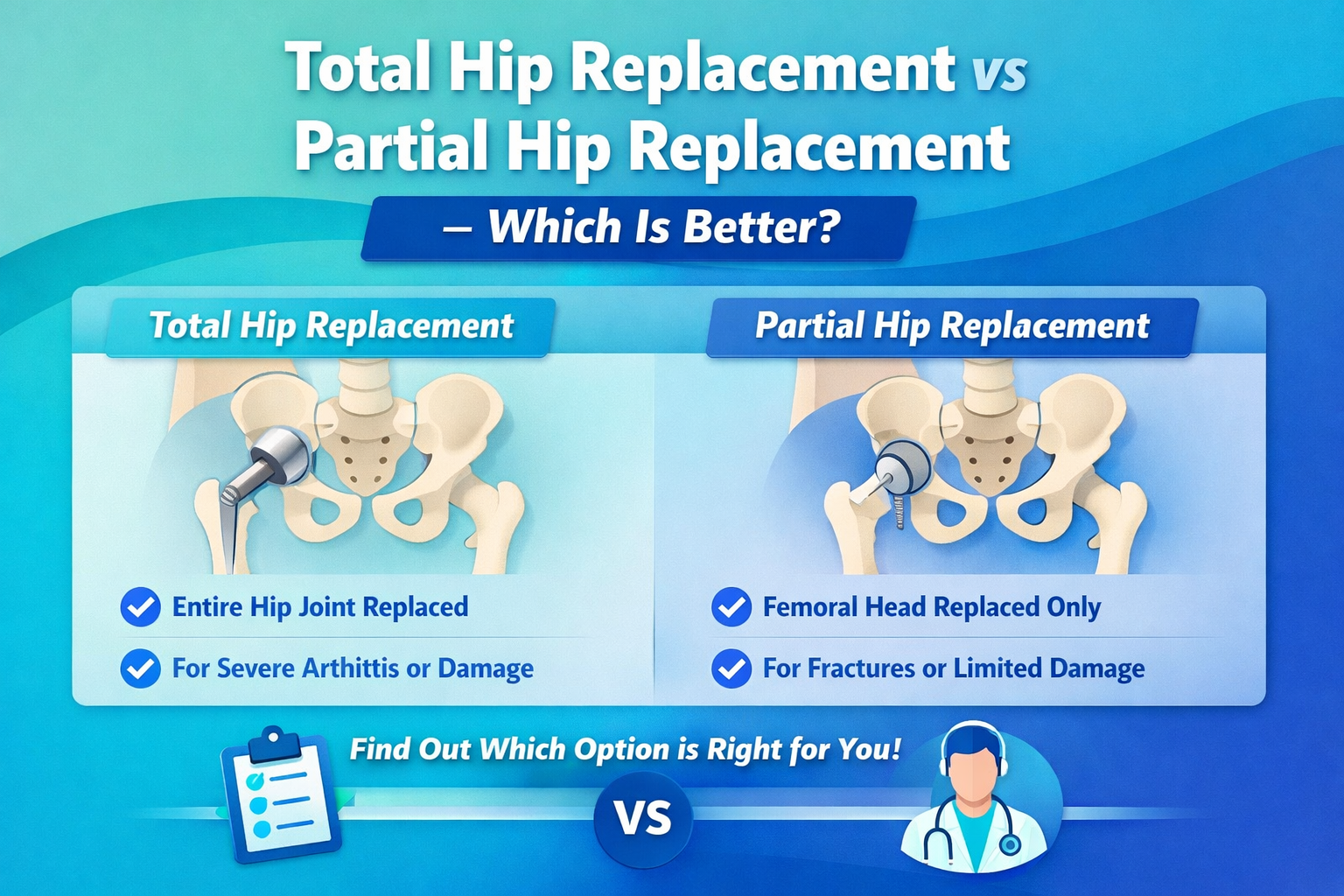
A total hip replacement is most often indicated in advanced cases of OA, RA, avascular necrosis, or general joint wear and tear, when both the head and socket are affected.
On the other hand, a partial hip replacement is usually reserved for a particular injury: a fracture in the part of the neck of the femur that fits into the socket, which is still healthy.
Hip replacement, total or partial, is usually considered when:
Total hip replacement is generally recommended for:
Partial hip replacement is generally recommended for:
Both procedures carry risks common to any major joint surgery, including infection, blood clots, and implant-related complications. A few differences are worth noting:
In general, total hip replacement tends to provide better long-term outcomes for patients with arthritis or broader joint damage, with implants often lasting 15-20 years or more.
Partial hip replacement is highly effective for its specific use case, isolated fractures with a healthy socket. Still, it isn’t designed to address arthritis, so it’s not a like-for-like comparison of “better” so much as “better suited” to different conditions.
Choosing between a total and partial hip replacement isn’t something to decide on your own; it depends on the extent of joint damage, your age, activity level, and overall health.
An orthopedic surgeon will usually confirm the right approach with a physical exam and imaging, such as an X-ray or MRI, before recommending the procedure best suited to your condition.
Living with hip pain shouldn’t become your new normal, and choosing the right procedure starts with the right diagnosis. Whether you need a total or a partial hip replacement, getting an expert opinion early can mean a faster return to walking, moving, and living without pain.
At Omar Hospital & Cardiac Centre, our orthopedic surgeons combine advanced surgical expertise with personalized recovery plans, guiding you from your first consultation through full rehabilitation.