

Types of Total Knee Replacement

Types of Total Knee Replacement

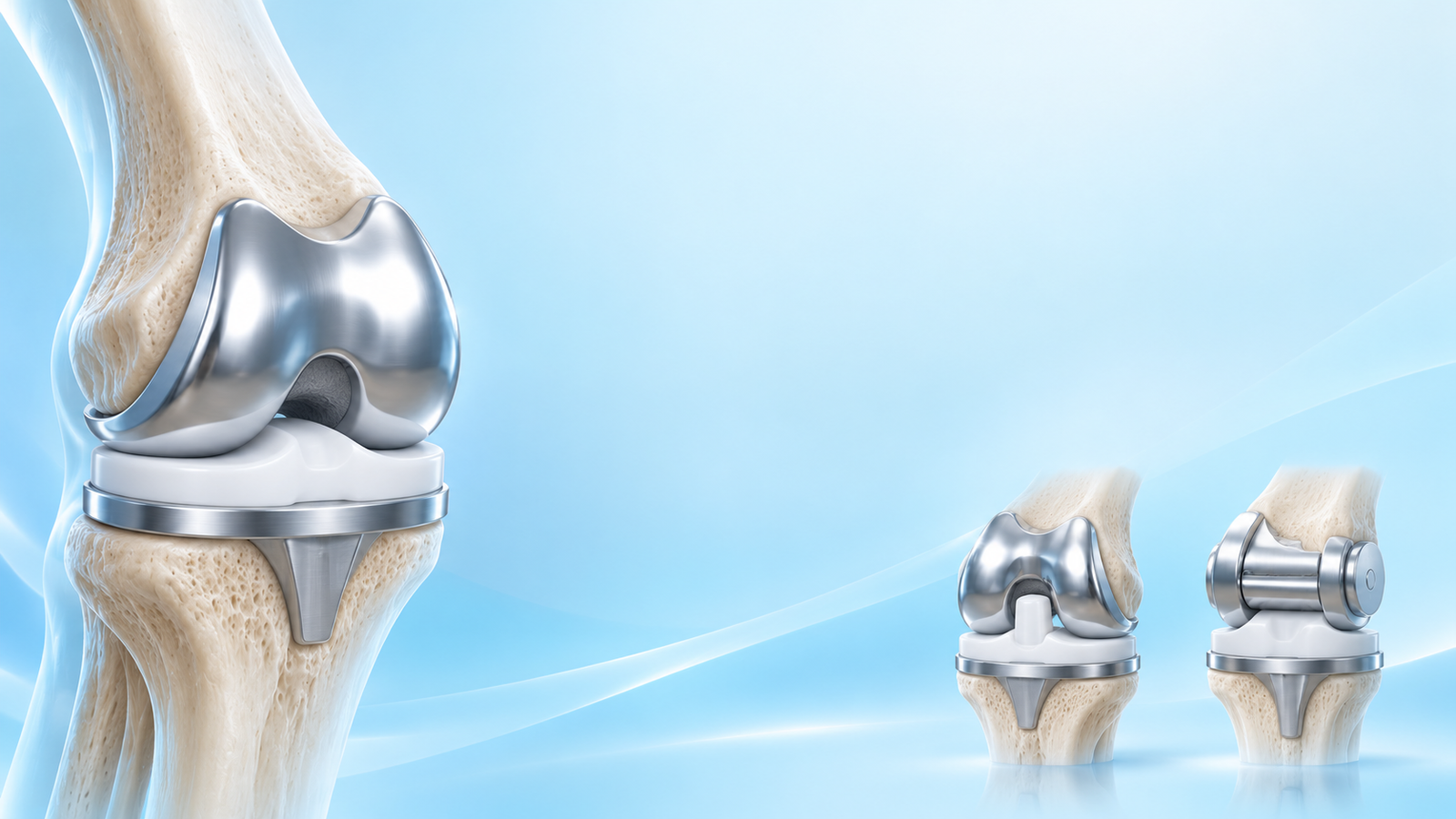
A total knee replacement, or total knee arthroplasty, is surgery in which doctors replace the worn-out parts of your knee with artificial implants. Doctors often recommend it when arthritis or an old injury makes it hard to move or enjoy daily life, and other treatments no longer work.

Not all knee implants are the same. They can attach to your bone in different ways, come in different shapes, and be placed using different techniques. This guide breaks down the main types of knee replacement in simple, everyday language.

Types of Total Knee Replacement by Fixation

Fixation just means how your new knee is attached to your bone.

  • Cemented: Special bone cement holds your implant firmly in place from the start. It’s the most common method and has been used safely for years.
  • Cementless: This type has a textured surface that lets your own bone gradually grow into it, holding it steady over time. Doctors often recommend it for younger or more active people with strong bones.
  • Hybrid: This blends both methods; for example, one part might be cemented while another is cementless, depending on what’s best for you.

Types by Implant Design

The main difference between implants is how they work with the ligament at the back of your knee.

  • Cruciate-retaining (CR): This type keeps your own ligament at the back of the knee, as long as it’s healthy and working well.
  • Posterior-stabilised (PS): If your ligament is damaged or you have a severe knee problem, this implant takes over the ligament’s job with a special built-in feature.
  • Fixed-bearing and mobile-bearing: In a fixed-bearing knee, the plastic part stays put, while in a mobile-bearing knee, it can move or rotate a little. Most people get fixed-bearing implants, but your surgeon will explain what fits you best.

Total Knee Replacement

Types by Surgical Technique

Surgical technique is simply how your doctor performs the knee replacement.

  • Conventional: The surgeon uses tried-and-true tools to guide the bone cuts.
  • Minimally invasive: This method uses a smaller cut and disturbs fewer muscles, which may mean a quicker recovery, but it’s not an option for everyone.
  • Computer-navigated: Special tracking tools help your surgeon line up your implant as precisely as possible.
  • Robotic-assisted: A robotic arm helps your surgeon make the planned bone cuts, but your surgeon remains in full control throughout.

Don’t hesitate to ask your surgeon about the different techniques and which ones might be best for your knee.

Related Knee Replacement Procedures

  • Partial (unicompartmental) replacement: Surgeons replace only the damaged part of your knee. This isn’t a total replacement, but it can work well if your arthritis is limited to one area.
  • Bilateral replacement: Surgeons replace both knees, either at the same time or in two separate surgeries, depending on your health and needs.
  • Revision replacement: If an old knee implant wears out or causes trouble, a revision surgery replaces or repairs it.

How the Right Type Is Chosen

There’s no one-size-fits-all answer. Your orthopaedic surgeon will help you decide after examining your knee and looking at your X-rays. They’ll consider things like:

  • Age and activity level
  • Bone quality
  • Condition of the ligaments
  • Shape and severity of the knee deformity
  • General health and any previous knee surgery

The right knee replacement is the one that fits your body and lifestyle, and a skilled, caring surgeon performs it.

Want to talk things over? Contact an orthopaedic surgeon at Omar Hospital in Lahore.

If knee pain is slowing you down, consider booking a visit with the orthopaedic team at Omar Hospital. After a checkup and scans, they’ll discuss whether you need a knee replacement and which type would suit you best.

Total Knee Replacement

SHARE THIS ARTICLE